Notes on Vintage Gear
- We're still updating pictures. If you want more pictures, just text us with the model number you're looking for (616-369-8366)
- Speakers & Turntables are in-store only in Grand Rapids, MI (they're delicate!)
- 1-year warranty on anything over $500. 30-day warranty on anything under $500. Excludes user error (ie if you blow it up). Return shipping responsibility of customer.


Yamaha
Yamaha CA-Ri
Yamaha CA-Ri
Overview
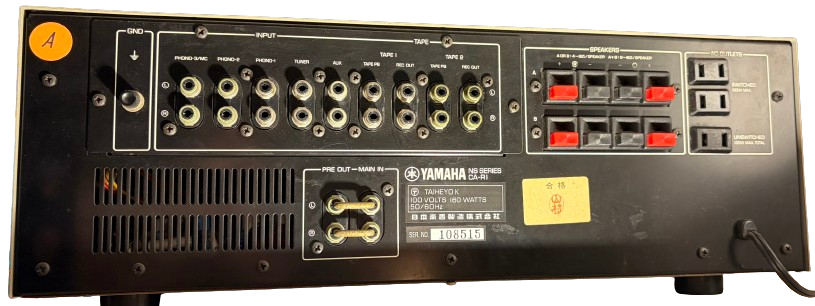
The model listed as the Yamaha CA-Ri is the Yamaha CA-R1, a substantial integrated amplifier from the late 1970s. Rated at 65 watts per channel into 8 ohms, it combines a capable power section with unusually extensive analog source facilities.
The CA-R1 offers three phono inputs, including provisions that made it suitable for listeners comparing multiple turntables or cartridge setups. It also includes selectable speaker outputs, tape monitoring, filters, continuously variable loudness control, and pre-out/main-in connections for integrating an external processor or power amplifier.
Why This Model Matters
The CA-R1 represents Yamaha's “Natural Sound” era at its most purposeful: clean industrial design, wide-bandwidth engineering, and controls intended to be useful rather than ornamental. Its restrained black-and-silver appearance differs from the more flamboyant receivers of the period, but the build and feature set place it firmly among Yamaha's serious hi-fi components.
Three phono inputs are particularly notable. At a time when vinyl was the primary source for many systems, the CA-R1 gave enthusiasts considerable flexibility without requiring an external switching box or separate preamplifier.
Highlights
- Late-1970s Yamaha Natural Sound integrated amplifier
- Rated at 65 watts per channel into 8 ohms
- Three phono inputs for flexible turntable setups
- Pre-out/main-in connections
- Continuously variable loudness control
- High- and low-frequency filters
- Understated Yamaha industrial design
Who It's For
The CA-R1 is well suited to a vinyl-focused listener who wants more input flexibility than most integrated amplifiers provide. It also makes sense for anyone drawn to Yamaha's clean design language and reputation for low-distortion, wide-bandwidth amplification.
Couldn't load pickup availability
Share