Notes on Vintage Gear
- We're still updating pictures. If you want more pictures, just text us with the model number you're looking for (616-369-8366)
- Speakers & Turntables are in-store only in Grand Rapids, MI (they're delicate!)
- 1-year warranty on anything over $500. 30-day warranty on anything under $500. Excludes user error (ie if you blow it up). Return shipping responsibility of customer.


Sony
Sony 333ES
Sony 333ES
Overview
The Sony TA-F333ES is a Japanese-market stereo integrated amplifier released in 1984 as part of Sony’s ES—Elevated Standard—line. Although this listing shortens the name to “Sony 333ES,” the correct model designation is TA-F333ES. It was positioned as a serious two-channel amplifier, with substantial internal construction, a wide range of analog inputs, and the understated black-and-wood presentation associated with early ES components.
Why This Model Matters
The TA-F333ES arrived at a point when Sony was expanding the ES name beyond source components and emphasizing higher-grade construction across complete systems. Sony promoted it as a modern successor in spirit to the company’s earlier TA-1150, pairing traditional integrated-amplifier usability with more advanced 1980s circuitry and a notably solid chassis.
This is not a CD player, receiver, or later home-theater “333ES” model. It is a dedicated stereo integrated amplifier with phono support for both moving-magnet and moving-coil cartridges, multiple line-level sources, tape facilities, tone controls, and connections for two speaker pairs. Its combination of serious build quality and relatively restrained styling has made the early Japanese ES amplifiers increasingly interesting to enthusiasts who know Sony’s less obvious high-end history.
Highlights
- Released in Japan in 1984
- Dedicated stereo integrated amplifier
- Moving-magnet and moving-coil phono capability
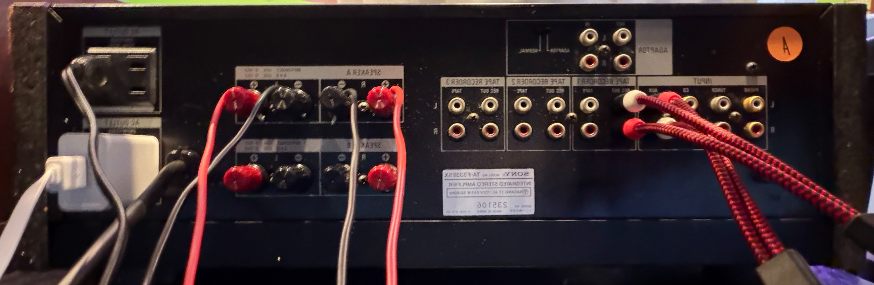
- Multiple line and tape connections
- Heavy-duty early Sony ES construction
- Original Japanese-market 100-volt model
Who It's For
The TA-F333ES is for listeners who want a substantial vintage Japanese integrated amplifier but prefer something less predictable than the usual Pioneer, Sansui, or Marantz choices. It is particularly attractive for an analog-focused system, though its Japanese-market voltage requirement should be considered before regular use in North America.
Couldn't load pickup availability
Share