Notes on Vintage Gear

Sansui
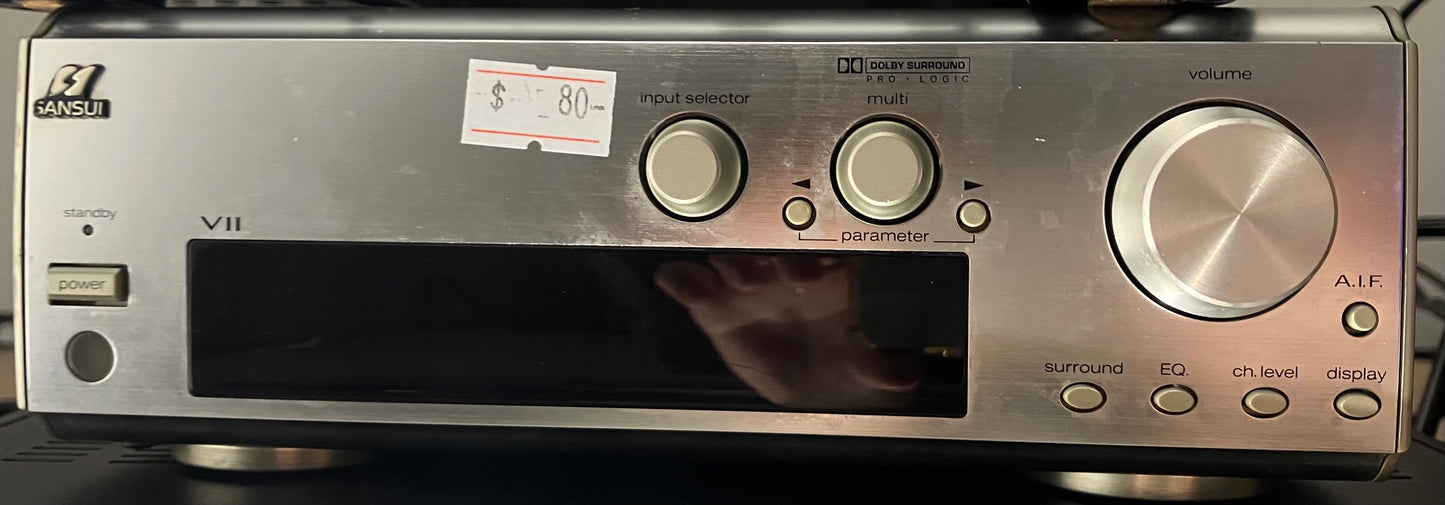
Sansui V11
Sansui V11
Overview
The Sansui V11 is a compact AV surround processor designed for Sansui’s System a/AS11 home-theater components. It is not a conventional two-channel stereo preamplifier. Instead, the V11 combines source switching, volume control, surround processing, and built-in amplification for center and rear speakers in a half-width chassis.
Why This Model Matters
During the late 1990s, Japanese manufacturers increasingly offered compact component systems that bridged traditional hi-fi and emerging home theater. The V11 belongs to that period. Rather than replacing a main stereo amplifier, it was intended to add movie-oriented surround capability around compatible Sansui components and speakers.
Its internal amplifier section is rated for center and rear-channel duty rather than high-powered front-speaker operation. Published specifications list 10 watts per channel for the center pair and 10 watts per channel for the rear pair into 6 ohms, with all four channels operating. That makes the V11 a specialized expansion component, not a stand-alone integrated amplifier.
Highlights
- Compact AV surround processor for the Sansui System a/AS11 family
- Source selection and master volume control
- Built-in amplification for center and rear channels
- Rated at 10W + 10W center and 10W + 10W rear into 6 ohms
- Designed for 6–16 ohm speaker loads
- LINE, LD, and VCR signal-to-noise ratio rated at 80 dB
- Half-width 200 mm chassis
Who It’s For
The V11 is most interesting to collectors assembling a complete Sansui System a/AS11 setup or enthusiasts drawn to compact Japanese home-theater components from the late 1990s. Because it was designed as part of a coordinated system, buyers should confirm compatibility with their intended speakers, sources, and main amplification before treating it as a general-purpose preamp.

Couldn't load pickup availability