Notes on Vintage Gear
- We're still updating pictures. If you want more pictures, just text us with the model number you're looking for (616-369-8366)
- Speakers & Turntables are in-store only in Grand Rapids, MI (they're delicate!)
- 1-year warranty on anything over $500. 30-day warranty on anything under $500. Excludes user error (ie if you blow it up). Return shipping responsibility of customer.


Pioneer
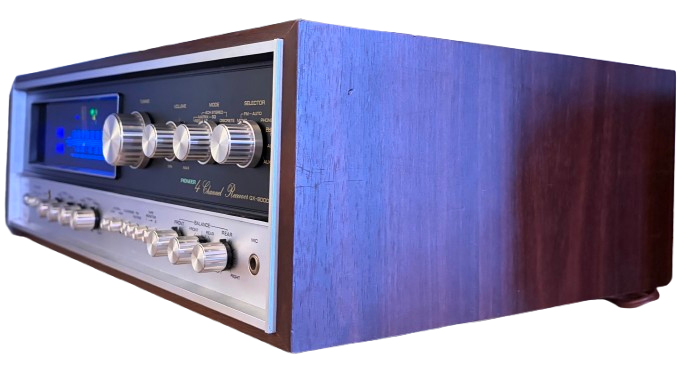
Pioneer QX-8000A
Pioneer QX-8000A
Overview
The Pioneer QX-8000A is an early-1970s quadraphonic receiver built during the brief but fascinating period when the hi-fi industry expected four-channel sound to become the next major home-audio format. It combines an AM/FM tuner, four independent amplifier channels, matrix decoding, and connections for discrete four-channel sources in one substantial receiver.
Published output is approximately 27 watts per channel in stereo operation and 22 watts per channel into 8 ohms when all four channels are used. That makes it capable of driving a full quadraphonic speaker array while still serving as a conventional two-channel receiver.
Why This Model Matters
The QX-8000A captures Pioneer at the height of the quadraphonic experiment. It was designed to handle ordinary stereo, matrix-encoded records and broadcasts, and discrete four-channel tape sources. Pioneer also included circuits that could derive a four-speaker presentation from standard two-channel material, giving owners something to explore even when true quad recordings were unavailable.
Today, its importance is historical as much as practical. Quadraphonic sound never settled on one universal format, but receivers like the QX-8000A preserve the ambition, complexity, and visual drama of that era.
Highlights
- Four-channel receiver from the early quadraphonic era
- Approximately 22 watts per channel into 8 ohms in quad mode
- Higher output available in two-channel stereo operation
- Matrix decoding and discrete four-channel capability
- Large silver-face Pioneer control layout
Who It’s For
Best for collectors of quadraphonic equipment, Pioneer enthusiasts, or anyone building a period-correct four-speaker system. It also works as a distinctive stereo receiver, though its real appeal lies in its unusually ambitious four-channel design.
Couldn't load pickup availability
Share