Notes on Vintage Gear


Kenwood
Kenwood TK-88
Kenwood TK-88
Overview
The Kenwood TK-88 is a late-1960s solid-state FM/AM stereo receiver, not a “TX-88.” Introduced during roughly 1967–1970, it was one of Kenwood’s early all-transistor receivers and reflects the company’s transition from its Trio roots into a major international hi-fi brand.
Why This Model Matters
The TK-88 comes from a period before receiver design settled into the familiar 1970s silver-face formula. Its dark dial, bright aluminum trim, white paddle switches, wood-grain case, and compact proportions make it visually distinct from later Kenwood models. Contemporary promotional material emphasized its FET-equipped FM front end, silicon-transistor amplifier, and 90-watt music-power rating. In modern continuous-power terms, surviving specifications place it at roughly 32 watts per channel into 8 ohms.
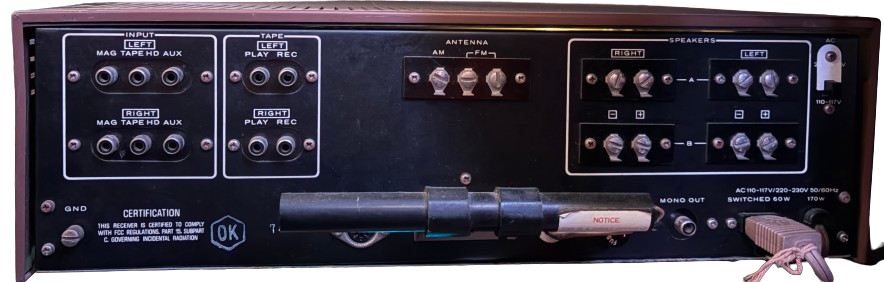
As an early solid-state design, the TK-88 is historically more interesting than its modest power rating might suggest. It offered the core functions expected of a serious component receiver—FM stereo, AM, magnetic phono, tape connectivity, tone adjustment, and multiple speaker outputs—at a time when transistorized home hi-fi was still relatively new.
Highlights
- Late-1960s solid-state FM/AM stereo receiver
- FET-based FM front-end circuitry
- Approximately 32 watts per channel into 8 ohms
- Originally promoted with a 90-watt music-power rating
- Phono, tape, and auxiliary connectivity
- Distinctive early Kenwood styling with wood-grain cabinet
Who It’s For
The TK-88 is best suited to enthusiasts drawn to the earliest generation of Japanese solid-state receivers. It pairs naturally with efficient period speakers and offers more historical character than a typical later-1970s receiver, particularly for collectors interested in Kenwood’s formative years.

Couldn't load pickup availability