Notes on Vintage Gear
- We're still updating pictures. If you want more pictures, just text us with the model number you're looking for (616-369-8366)
- Speakers & Turntables are in-store only in Grand Rapids, MI (they're delicate!)
- 1-year warranty on anything over $500. 30-day warranty on anything under $500. Excludes user error (ie if you blow it up). Return shipping responsibility of customer.


Kenwood
Kenwood KR-6200
Kenwood KR-6200
Overview
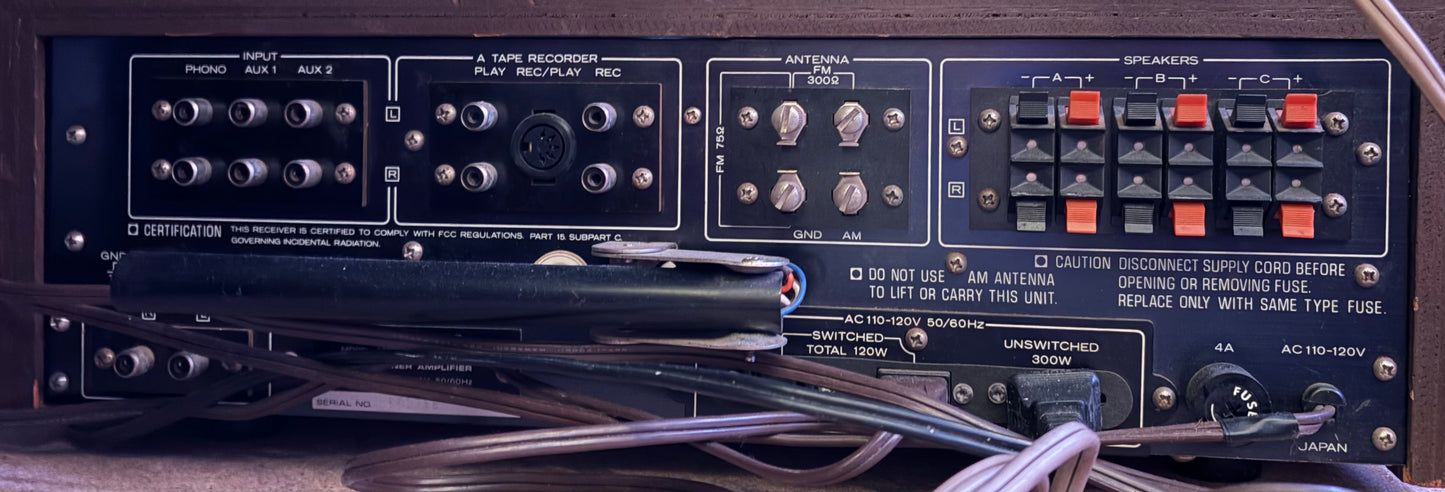
The Kenwood KR-6200 is an early-1970s stereo receiver rated at 45 watts per channel into 8 ohms. Sold under the Kenwood and Trio names depending on market, it combines a substantial amplifier, FM/AM tuner, phono capability, and flexible source switching in the clean brushed-aluminum style that defined the period.
Why This Model Matters
The KR-6200 arrived before the most extravagant phase of the receiver power wars, when 40 to 50 honest watts per channel still placed a component well above entry level. It was part of a Kenwood lineup known for practical engineering and strong tuner sections, and its 29-pound chassis reflects a build more substantial than its understated faceplate initially suggests.
For vinyl listeners, the receiver is particularly useful because it provides moving-magnet phono support along with microphone and line-level inputs. Its 20 Hz to 40 kHz stated frequency response and 0.5% rated total harmonic distortion are typical of a well-specified receiver from its era. The result is not a novelty piece, but a versatile control center built for a complete two-channel system.
Highlights
- Early-1970s Kenwood/Trio stereo receiver
- 45 watts per channel into 8 ohms
- FM and AM tuning
- Moving-magnet phono and microphone inputs
- Connections for multiple speaker pairs
- Heavy 29-pound construction
Who It’s For
The KR-6200 is a strong fit for someone who wants classic receiver aesthetics and enough power for a broad range of vintage speakers without moving into the largest, most expensive models. Its useful input selection also makes it easy to build a period system around both vinyl and tape.
Couldn't load pickup availability
Share