Notes on Vintage Gear

Denon
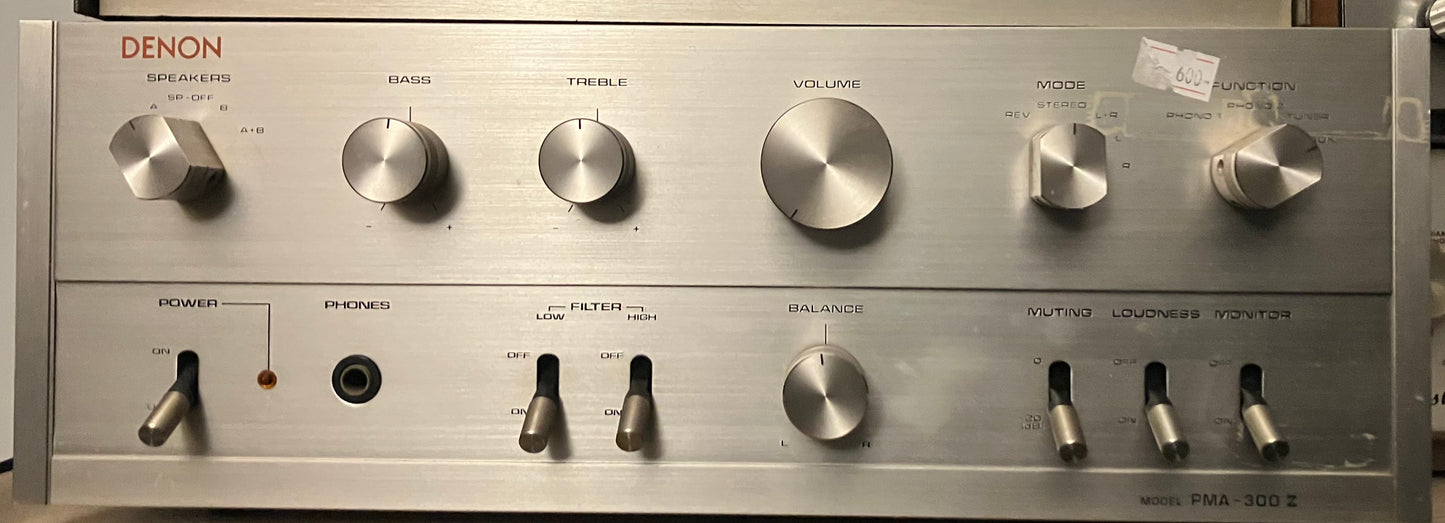
Denon PMA-300Z
Denon PMA-300Z
Overview
The Denon PMA-300Z is an early solid-state stereo integrated amplifier from the period when Denon was still widely associated with its Nippon Columbia heritage. Rated at 17 watts per channel into 8 ohms with both channels driven, it was designed as a compact but fully equipped control center for a home hi-fi system.
Its feature set is more ambitious than the power rating suggests. The PMA-300Z provides two phono inputs, tuner and auxiliary inputs, connections for two tape decks, and outputs for two pairs of speakers. The preamplifier and power-amplifier sections can also be separated, giving the unit flexibility that was uncommon on many entry-level amplifiers.
Why This Model Matters
The PMA-300Z captures an important stage in Denon’s amplifier history: the transition from tube-era design traditions into all-silicon transistor electronics. Its complementary OTL/OCL output circuit and broad specified frequency response show how seriously manufacturers were pursuing lower distortion and wider bandwidth during the early 1970s.
This is not a high-powered amplifier, but it was never intended to be. Its strengths are versatility, period construction, and the ability to support a surprisingly complete analog system.
Highlights
- 17 watts per channel into 8 ohms, both channels driven
- Two phono inputs
- Two tape loops with RCA and DIN connections
- Pre-out/main-in separation capability
- Outputs for two speaker pairs
- High- and low-frequency filters
Who It’s For
The PMA-300Z is best matched with efficient speakers in a modest room. It should appeal to Denon collectors, vinyl listeners who need more than one phono connection, and enthusiasts drawn to less common Japanese integrated amplifiers from the early solid-state era.

Couldn't load pickup availability